20110320
Adder (Vipera berus) – Norfolk
Labels:
Adder (Vipera berus)
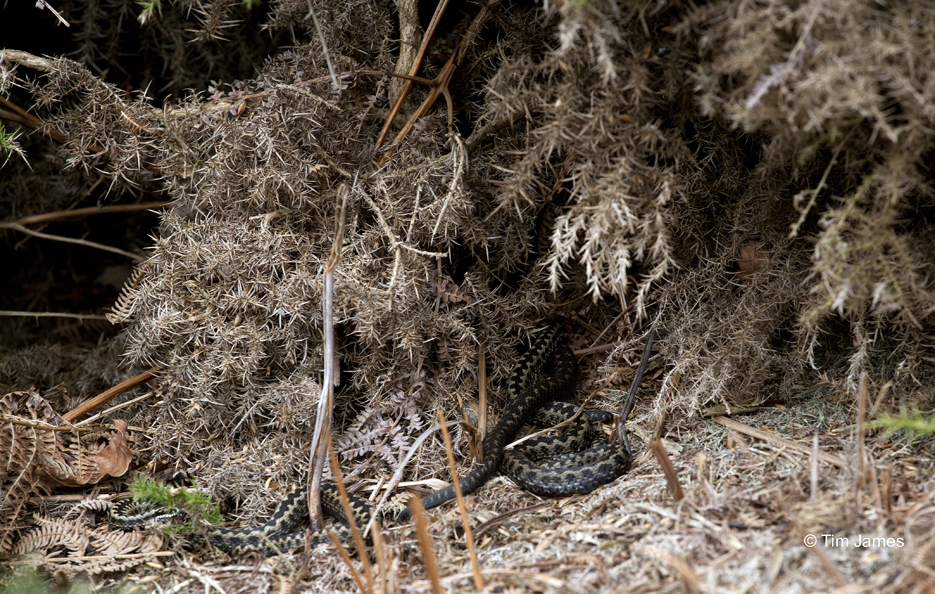
I have become fascinated by Adders (Vipera berus) and – as my knowledge of them has improved – I've also become much more adept at finding them. And with a colony of the reptiles just 10 minutes or so from the house, I've been able to make time to take plenty of shots, but also simply to sit and observe them. With the males and females having hibernated for around 150 and 180 days respectively – venturing from their burrows only once the ambient temperature rises above 9ºC – they now spend much of their time basking in whatever sunshine is available. For this reason, I find the best time to spot them is in the mid-mornings, when the sun has started to warm up the ground and is providing enough heat for the adders themselves to recharge their metabolic batteries. I've also included a few context shots to illustrate how the snakes prefer – at least at this time of the year when the sun is still relatively weak – to do their basking close to dense gorse or shrubs into which they can flee when disturbed.
Spot the Frog
I was photographing this pond which was simply brimming with frog spawn and – concentrating on not falling in and also on exposing the shot correctly in the face of the first harsh sunlight of spring – I completely failed to notice that throughout I was being watched by a frog keen to safeguard its watery maternity ward of potential offspring. Scroll down just a little if you can't see its watchful eyes…
Canon 1Ds MkII, 1/800 sec, f/8, 200mm at ISO 400
20110319
Minotaur Beetle (Typhaeus typhoeus)
The Minotaur Beetle (Typhaeus typhoeus) is a spectacular dung beetle of heaths, moorlands and mountains, this male shot in an area of managed heath in North Norfolk. The males use the long prongs on the thorax to compete for mates. Their principal food source is rabbit droppings. How I wish I'd had a macro lens with me at the time, this image failing to capture the beetle's impressive armour.
Canon 1Ds MkII, 1,1,000 sec, f/3.5, 70mm at ISO 640
White-rot Fungus
I saw this beautiful specimen of fungi while hunting for adders. The rings of colour in the body of the organism were as vivid as if they had been painted on; presumably the result of the changing make-up of the lignin being digested from the birch stump. My knowledge of fungi is poor, however, so any help in establishing whether this is an example of White Rot fungi (Trametes ochracea) would be very much appreciated.
Canon 1Ds MkII, 1/1,000 sec, f/2.8, 62mm at ISO of 640
20110318
Adder (Vipera berus) – Norfolk
Labels:
Adder (Vipera berus)
This afternoon I spent the most wonderful couple of hours searching for Adders in an area of North Norfolk known as the Holt Lowes. The area – a Site of Special Scientific Interest (SSSI) and a Special Area of Conservation (SAC) – is a stronghold for Adders, the habitat a perfect mix of heath, gorse, some bog and sand. On setting out, I wasn't too hopeful; the day was cool and the sun was struggling to show behind a blanket of light grey cloud. Soon, however, it broke through and conditions became perfect, albeit that it was still only mid-March and these cold-blooded reptiles need a lot of warmth to get going. This is going to sound weird or just plain obvious, but I find the key to spotting wildlife is to know what you're looking for. By that I mean having a fair idea of shape, colour, posture, probable choice of location and, of course, size. The other truesim is that once you've seen something once and the brain stores the image, it's a lot easier from that point onwards. I have walked this area a hundred times and – not consciously looking for snakes – had never seen one. This time, I told myself not to look for a line (the chances of seeing a moving snake were, I suspected, slim) but a ring or circle (the logic being that my best chance would be to find an Adder basking in the first ray's of the sun in an effort to generate enough warmth to start hunting. Though venomous, Adders are not aggressive and are also less inclined to disappear to disappear into the undergrowth unless threatened; it is possible safely to get quite close without disturbing them. And so it proved – within 20 minutes, 10 metres ahead of me I did indeed pick out a circle of darkness against the lighter mix of long grasses and ferns and was able to take these shots. I went on to find four more: three alive and one dead, with two puncture wounds a few inches below the head.
Both Canon 1DS MkII, 1/2500 sec, f/4, 200mm at ISO 640
20110317
Bumblebee
I love serendipity. Earlier today, Frank of The Early Birder fame, posted a message that he'd seen quite a few more Bumblebees out and more active over the last few days, the daytime temperatures having lifted just enough to get them going. I then spotted this large and beautiful Bumblebee on the gravel drive next to my car. It was barely moving and, when very gently touched, was disinclined or unable to move off. Clearly, it needed warming up a little and I was able to achieve two ends: I would be able to get these hurriedly taken shots and the bee would get the chance to get some warmth into its muscles. I also took a moment to do a little research and hadn't realised that the bee's buzzing is not, in fact, caused by the movement of its wings, but by the bee actually vibrating its flight muscles. And – rather like it's best to allow a car engine to warm up on a cold morning – they must do this if the ambient temperature is low before they are able to take to the air. To achieve this they can do something rather cool – like a car can be revved in neutral, so the the Bumblebee is able to de-couple its wings from the muscle attachments, so it can warm up the thoracic powerhouse ready for flight. Rather, I imagine, like us being able to shiver in overdrive. Indeed, so effective is this adaptation in the bee that internal temperatures around the flight muscles can reach a staggering 30ºC (or 86ºF in old money). I should also add that, after a few minutes under a lamp in the office, the bee did indeed manage to reach optimum temperature again and, returned to the honeysuckle outside, flew off with gusto.
Red Panda (Ailurus fulgens)
Labels:
Red Panda (Ailurus fulgens)
One of my favourite creatures and sadly so under threat. These shots are more from a series taken earlier in the year. I include them here with another reminder that to learn more about the plight of these wonderful animals, whose habitat and food resources are being destroyed at an alarming rate, take a look at: http://redpandanetwork.org/
All Canon 1Ds MkII
1. 1/100 sec, f/8, 400mm at ISO 640
2. 1/125 sec, f/8. 352mm at ISO 640
3. 1/100 sec, f8, 400mm at ISO 640
Gossiping Otters
Labels:
Otter
Yes, I know I've written before that I don't like anthropomorphism in wildlife photography, but it can sometimes be hard to resist. These Otters just look as if they are catching up on a few things, with one seeming to whisper to the other.
Canon 1Ds MkII, 1/125 sec, f/8, 326mm at ISO 400
Emu in the rain
Labels:
Emu
This Emu – drenched and seemingly miserable – was intrigued by the camera lens, providing me with a nice shot of its stunning eyes. I also like the rain-sodden curl of its feathers and the grains of sand and grit that cover its head. If only the light had allowed a slightly larger depth of field.
Canon 1Ds MkII, 1/500 sec, f/2.8, 63mm at ISO 400
Bactrian Camel
Labels:
Bactrian Camel
A zoo shot, but I just love the thick, unctuous and pretty foul-smelling saliva being produced by this Bactrian Camel and the detail in its fine whiskers.
Canon 1Ds MkII, 1/320 sec, f/9, 290mm at ISO 640
20110316
First bees of spring
In the garden, the honeysuckle, daffodils and crocuses are either in flower or just starting to show and the arrival of colour and scent for the first time in months has brought out the occasional Bumble Bee. This one declined to dwell very long, the light was poor and – without a macro lens on the Canon body – I wasn't able to get very close. But the composition still works, I think, and it does feel good to contemplate that warmer weather, brighter and longer days and, of course, an abundance of visitors to the garden are really not that far away.
Canon 1Ds MkII, 1/250 sec, f/4, 200mm at ISO 400
20110314
Blue Tits
Labels:
Blue Tit (Cyanistes caeruleus)
Photographing garden birds is my default mode; it's what I do whenever the chance presents itself and more complicated or involved shooting is not a possibility. If I get a spare 15 minutes from work in the office, I take my camera into the garden and see what's around. If I'm at my desk and notice the light has changed, I do the same. These shots were all taken within 30 minutes or so, when the sun was just starting to dip over the horizon and a beautiful pale glow was being cast over the garden. Just humble, common or garden Blue Tits, but no less captivating for that.
All Canon 1Ds MkII, 1/60-1/125 sec, f/8, 400mm at ISO 400
Sparrowhawk
Labels:
Sparroew,
Sparrowhawk (Accipiter nisus)
This Sparrowhawk made a meal of a Woodpigeon in my garden, leaving its tell-tale scattering of the plucked breast feathers close by. I noticed the carcase when I went out to top up the bird feeders and, while I was seated on a bench watching robins, tits and finches taking peanuts and seeds, the Sparrowhawk returned for seconds. As I slowly raised the camera, it predictably took to the wing. But the bird had returned at least once, so I thought it might be willing to do so again. I picked up the carcase and – because Sparrowhawks are generally reluctant to eat in the open – I placed it toward the edge of the garden, close to thick hedgerows and, a little further on, a large wood. This, I hoped, would allow the raptor to wait on a branch on high and come in again when it felt the coast was clear and, if it felt more comfortable, drag its meal into the undergrowth. Unfortunately the plan worked rather too well; the Sparrowhawk did indeed return, but before I was hidden and settled. As I attempted to get close enough for a decent shot, it flew off once more, but not before I had managed to fire off just a few frames. Now, the pigeon carcase is back in position. Let battle commence…
Canon 1Ds MkII, 1/80 sec, f/8, 400mm at ISO 200
20110311
The sky at night
Something just a little different, but the night sky over Norfolk was too good to miss. The exposure time was a matter of guesswork to begin with, but I settled on an intermediate 15 seconds at f/4.5. With the camera steady on a very robust tripod, the two settings together allowed for the moon not to dominate, the house lights to gently illuminate the brickwork and doors of the derelict cottage nextdoor and the stars to shine out just enough. I'm really pleased with the results. PS: I've kept this image large on screen – if it proves to be too big, post a message and I'll drop the size down.
Canon 1Ds MkII, 15 sec, f/4.5, 17mm at ISO 500
20110310
The frustrations of this passion of ours
Walking the dogs this morning, I was struck by how frustrating sometimes this passion we share for photography and wildlife can be. I spotted a family of buzzards – a mother and two recent fledglings, I believe – hunting around a copse close to the house. But without my camera and needing to be back in the office, there was nothing I could do except to enjoy the spectacle for a few minutes before heading off. The early morning sun was out and the light would have been perfect to capture some shots of these stunning birds. But by the time other more mundane matters had been sorted out, time had marched on, clouds had returned once again and the light was poor. I could, of course, resolve to carry a camera with me at all times (in reality I usually do), but to do the buzzards justice would have required a substantial lens and more than a little patience. In other words, not a snap shot. Ah well, maybe another time...
20110305
Black-headed Gull
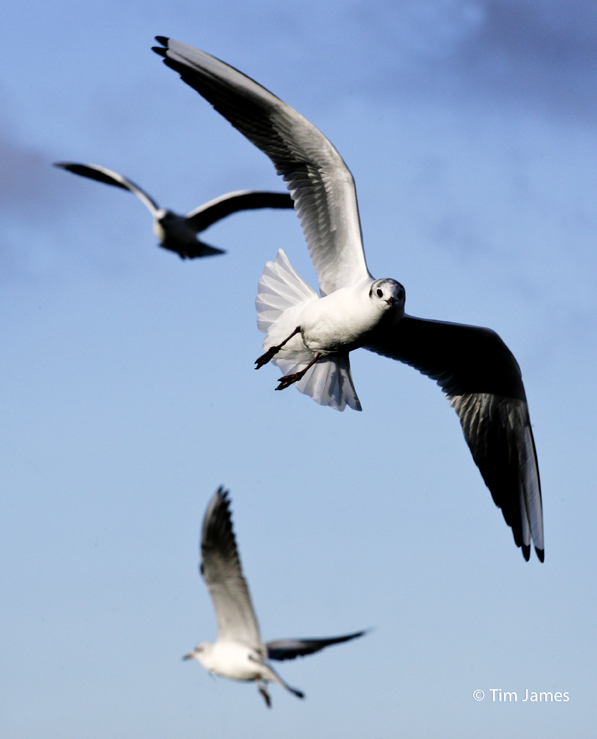
I'm a great fan of these gregarious, bold and sometimes downright cheeky birds. Photographing them is always a toss-up between a frame filled with fantastic action or, often enough, a frame empty apart from blue sky or a blur of wings. They're quick on the wing – able to turn on a sixpence – and in the water (at least when there is food about) they are frantic in the desire to gobble up whatever they can. In the first shot, the bird on the left had just stolen a chunk of bread from the other; it can be seen just about to disappear down the gull's throat. In the second, I simply like the way the gull caught by the camera's motion focus appears to be looking straight down the barrel of the lens.
Canon 1Ds MkII
1. 1/800 sec, f/8, 200mm at ISO 400
2. 1/1,600 sec, f/11, 200mm at ISO 400
Canon 1Ds MkII
1. 1/800 sec, f/8, 200mm at ISO 400
2. 1/1,600 sec, f/11, 200mm at ISO 400
20110227
Flights of fancy
Another brief collection of shots of birds in flight around a feeder, this time a trio of finches and a tit. I like trying to capture smaller birds in flight – unless the light is perfect, photographically it can be challenging – a fast enough shutter speed to freeze the action, while maintaining an aperture size wide enough to allow in enough light is a fine balancing act. But I think it's worth it; images of branch-bound songbirds abound, but there are far fewer showing what birds do best.
20110226
Common Frog
I rescued this Common Frog from my cat (on some images you may still be able to pick out a few stray feline hairs) and carefully placed it on this log in my garden, hoping it would not immediately leap off and disappear into the undergrowth. It complained a little – letting out a plaintive mid-pitch mini-croak, not unlike – ironically – a kitten's mew. But as it was, as a model the frog couldn't have been more obliging. With cloud cover meaning little available light, I mounted the camera on a tripod while the frog slowly explored its new surroundings. They are, I think, wonderful little creatures, each a unique mix of markings and each subtly different in their colouring, from a deep green-brown to almost olive. This one – a female, I think (the males have a hard swelling on the first finger to grasp their partner during mating) – was more sandy. The Common Frog is, as its name suggests, widespread throughout the UK, but still, I think, a magical sight.
Canon 1Ds MkII, 1/125-250 sec, f/2.8-6.3, 70mm at ISO 500
20110224
Just because I like the shot
Nothing more, nothing less. A common or garden Blue Tit, but I like the simplicity of the image and the detail in the bird's twig-like legs and feet as it grasps on – somehow – to a feeder pole that would seem to offer no chance of any purchase.
Canon 1Ds MkII, 1/400 sec, f/4, 200mm at ISO 400
Blackbird
Labels:
Blackbird (Turdus merula)
I know, it's just a humble Blackbird. But I actually think they're very attractive birds. In the right light the black feathers have a real sheen and those brilliant orange-ringed eyes are stunning.
Canon 1Ds MkII, 1/2,000 sec, f/4, 200mm at ISO 800
Greenfinch
Labels:
Greenfinch (Carduelis chloris)
Another shot attempting to catch the action of flight, this time a Greenfinch. I particularly enjoy the way the finch seemingly has eyes for only one thing.
Canon 1Ds MkII, 1/1,000 sec, f/5.6, 268mm at ISO 800
Chaffinch on the Wing
Labels:
Chaffinch (Fringilla coelebs)
It was so wonderful today to see the return of some sunshine after week after week of endless grey. I took the opportunity to spend an hour in the hide close to the bird feeder, hoping the improved light would offer up the chance of shooting some finches in flight. As it was, the sun chose that moment to hide behind thin cloud and the conditions were not ideal. Undeterred, however, I bumped up the ISO, opened up the aperture and left focus almost to chance and managed a few shots. None is terribly sharp and all suffered from inevitable noise issues, but these two are fun.
Canon 1Ds MkII, 1/1,000 sec, f/5.6, 268mm at ISO 800
20110220
Barn Owl
Labels:
Barn Owl (Tyto alba)
Barn Owls do exactly what it says on the tin. They have evolved to be silent hunters and they do it with graceful efficiency. They possess, of course, impressive talons: four toes, three of which face forward when the bird is in flight and the uniquely flexible outer front toe on each foot can swivel round to face backwards when the bird is at rest. The bone structure in the Barn Owl's feet are also shorter and stronger than the equivalent bones in most other birds, giving this consummate hunter an advantage – these high-stress limbs can withstand the considerable relative force of an impact with its prey. But in these images, I've concentrated on body feathers and the organs that provide the owl with super-senses – its eyes and the ears. Compared to most birds, Barn Owls have a very low wing loading, meaning that relatively large wings support a relatively small body mass. Its feathers are very soft, another adaptation for quiet flight, and they are covered in a discreet layer of tiny hairs that trap air within the feather surface. In addition to these adaptations, the Barn Owl's foremost wing feather (the 10th primary) has a row of tiny hooks that help to deaden the sound of air hitting the wings' leading edge. Together, these adaptations mean almost silent flight is possible, allowing ambush by stealth twinned with the ability to detect the small sounds produced by their small mammal prey. In January, I found a dead, ringed Barn Owl on the farm on which I live and – once I had passed on details of the release data to the BTO – I took the opportunity to examine its unique auditory set-up. The owl's heart-shaped face – the equivalent of our outer ear – acts like a huge radar, picking up and directing even the most delicate sounds into the inner ear. And those inner ears – hidden beneath its head feathers and each of them different in shape and sited asymmetrically with one higher than the other – mean the bird can further compute the signals received to finesse its hunting plan. Then there are the eyes. Huge in comparison to the size of the head and twice as sensitive to light as our own eyes, the owl can hunt for prey in near darkness and, with details in what we would see as shadows, the bird can detect even the slightest movement in the blackness. A most beautiful killer…
Source: The Barn Owl Trust ( www.barnowltrust.org.uk )
Canon 1Ds MkII, 1/640 sec, f/4, 180mm at ISO 500

Red Deer hinds
Labels:
Red Deer
I was drawn to the two sets of two in this shot. The Red Deer hinds were on high alert, ears pricked up as they became aware of my presence, so I backed off a little. But not before noticing the two cock Pheasants walking across the shot.
Canon 1Ds MkII, 1/80 sec, f/8, 400mm at ISO 500
20110215
Long-tailed Tit and Blue Tit
Labels:
Long-tailed Tit
Another one of those happy accidents that photography serves up every once in a while. This shot was taken on a gloomy day, with fast shutter speeds near impossible without considerable commensurate noise from a bumped up ISO. In the end I was shooting at 1/25 sec and not hoping for much. I was trying to capture a shot of this Long-tailed Tit sitting on a branch alongside a Blue Tit. Though they obliged by dwelling a while, even the slightest movement meant a blurred shot. The lack of sharpness on the Long-tailed Tit means this is no gallery image. But the framing of its body in the wing movement of the fleeing Blue Tit is a serendipitous composition.
Canon 1Ds MkII, 1/25 sec, f/8, 400mm at ISO 640
Tiger
I make no apologies for including another brace of zoo images – partly because it's been so horribly grey here and I haven't been out shooting, but principally because these majestic creatures need all the help they can get. According to the WWF, three tiger sub-species – the Bali, Javan, and Caspian – have become extinct in the past 70 years. The six remaining sub-species – the Amur, Bengal, Indochinese, Malayan, South China, and Sumatran tigers – are all threatened by poaching and habitat loss. Indeed, in the last 100 years, tiger numbers have fallen by a staggering 95%, with only an estimated 3,200 now left in the wild. For more, visit http://www.worldwildlife.org/species/finder/tigers/index.html
1. Canon 1Ds MkII, 1/250 sec, f/8, 400mm at ISO 640
2. Canon 1Ds MkII, 1/80 sec, f/10. 400mm at ISO 640
Both images alas shot through glass
1. Canon 1Ds MkII, 1/250 sec, f/8, 400mm at ISO 640
2. Canon 1Ds MkII, 1/80 sec, f/10. 400mm at ISO 640
Both images alas shot through glass
20110213
Red Panda
Labels:
Red Panda (Ailurus fulgens)
I've tried on a number of occasions to photograph one of the captive Red Pandas at Banham Zoo in Norfolk, but on every occasion this shy and solitary creature has alluded me. This one, however, was feeling positively social, happy to munch on fruit atop a log frame. The Red Panda (Ailurus fulgens) is native to the eastern Himalayas and south-western China. It is the only species of the genus Ailurus. It feeds mainly on bamboo, but is omnivorous and may also eat eggs, birds, insects, and small mammals. The Red Panda has been classified as vulnerable by the International Union for the Conservation of Nature (IUCN) because its population is estimated at less than 10,000 mature individuals. The usual suspects line up as the reasons behind its continuing decline – habitat loss and fragmentation and poaching.
Canon 1Ds MkII, 1/160 sec, f/9, 318mm at ISO 640
Subscribe to:
Posts (Atom)